THE WORLD OF WORDS
THE NEFF ZONE -- BY JIM NEFF
CADILLAC NEWS -- JUNE 13, 2026
All of us speak at least a few hundred words every day and some of us may even generate a few thousand. So, sometimes it can be enlightening to venture into the wonderful world of words.
Since it's baseball season, let's start there. The word “umpire” was not always associated with a sport. “ When a certain word or spelling variation gets used often enough, it gains the attention of lexicographers. Let’s take a closer look at some words that started their journey into English as mistakes.”
Umpire entered English as a mistranslated French loanword (nonper) in reference to a third-party authoritative judge. When it was brought into English, the initial 'n' was incorrectly dropped. The misdivision result, umpire, became the official English version of the word by the mid-14th century. It was eventually brought into gaming and sports (where it’s most commonly used today) in the early 18th century.” (https://wordsmarts.com/scandinavia-syllabus/)
Umpire is an example of on old word used today, but there are new words added to the dictionary all the time. In 2021, 'amirite' was added. “The expression is often used as a tag question, a term tacked on to the end of any statement in order to gain assent.” You probably didn't know that, amirite? More recent additions at: https://wordsmarts.com/popular-foreign-language-idioms/.
Some words are not in the dictionary yet, but Merriam-Webster has hundreds on a watch list. They include: sussy baka, bed rotting, borg, cheugy, and zaddy. My favorite refers to something that frustrates many of us – enshittification. “That's when a digital platform is made worse for users, in order to increase profits.” More at: https://www.merriam-webster.com/slang.
Many new words will, no doubt, become useful for us. Some may even be: “The greatest thing since sliced bread.” That phrase, however, only dates back to the 1920s. “The earliest effective bread-slicing machine was created by an Iowa inventor. Chillicothe Baking Company was the first to sell presliced bread, so they used a version of this idiom in their advertising: 'The greatest forward step in the baking industry since bread was wrapped.' Today, the phrase refers to excitement for a new concept or idea.”
Want something to put on that sliced bread? Maybe you need to: “Bring home the bacon.” That phrase has at least one (fun) possible origin. “One suggests that in the 1100s, married couples in a small town in England who visited the church and swore they hadn’t argued in the last year would be awarded a side of bacon to bring home.” More idioms at: https://wordsmarts.com/food-idioms/.
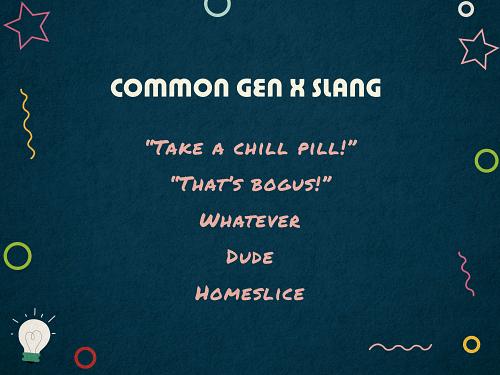
There are also words that identify when you were born and raised. Gen X words are an example. “Born between baby boomers and millennials, the members of Generation X are marked by unique cultural influences, a rebellious spirit, and distinctive language. Gen Xers are typically defined as folks born between 1965 and 1980, and they grew up under the effects of cable television, new musical genres, and a changing economy.”
You can tell a Gen X “dude” by the “gnarly” way they talk to a “yuppie” when discussing “headbanger” music. Everyone needs to just take a “chill pill” and mellow out. (https://wordsmarts.com/gen-x-slang/)
Sometimes both old and new words can be confusing. This is especially true when a word contains a silent letter, like the “k” in knight or the “w” in answer. History provides an explanation. “Grammatically, silent letters are known as empty letters. But you may be surprised to learn that these letters weren’t always silent. Then around 1400, English underwent what’s known as the Great Vowel Shift. During this period, the pronunciation of many words changed dramatically, though the spelling of those very same words often stayed the same. This confounding schism resulted in many of the silent letters that still exist today.” (https://wordsmarts.com/silent-letters/)
Even the best of us can be challenged by spelling. Back in my day, Fred Flintstone and I had to study lists in our spelling books or face the scorn of more proficient classmates. These days life is easier. “In the modern age of spell check and AI, our mistakes are corrected for us in the blink of an eye.”
Still, even with technology spelling can be tricky. Google notes: “Whether it's a word with silent letters, unexpected double consonants, or confusing vowel combinations, search results reveal just how challenging English spelling can be, even in the digital era.”
In an interesting twist, each state has a word that most people misspell. Among these are: business (Alabama), school (Florida), ukulele (Minnesota), spaghetti (Virginia), and chihuahua (Wyoming). In Michigan, “which” seems to vex us. See all the states at: https://www.mentalfloss.com/language/spelling/most-misspelled-word-every-state.
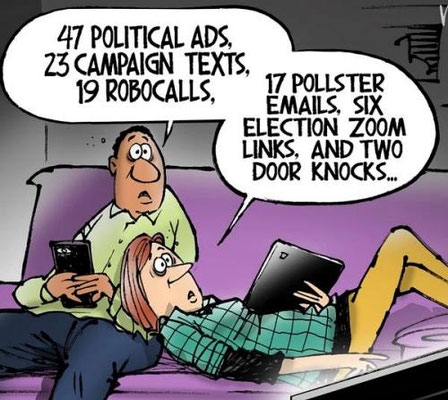
Finally, I need to put on my curmudgeon hat for a comment on a word. Are you already tired of all the political ads on TV, radio, and social media? Is your postal mailbox overflowing with solicitations? I have a way to end it all in one swoop. Make it illegal to use the word “fight” (or any variation) in a political ad. All political ads would cease immediately.
Jim Neff is a local columnist. Read Neff Zone columns online at CadillacNews.com and NeffZone.com/cadillacnews.